Editions 009
Neri Oxman
Editions 009
Neri Oxman
Editions 009
Neri Oxman

Neri Oxman has never fit comfortably into a single discipline. Trained as an architect, inspired by biology, and driven by advances in computation and robotics, she has spent her career questioning the boundaries that traditionally separate design, science, and engineering. While most designers begin with form or function, Oxman begins with systems, asking how nature creates, adapts, and regenerates. It’s an approach that has made her one of the most influential design thinkers of the past two decades, not because she designs beautiful objects, but because she challenges the very process by which they’re made. Her work suggests that the future of design won’t be defined by better products alone, but by entirely new ways of imagining materials, manufacturing, and our relationship with the natural world.
Neri Oxman has never fit comfortably into a single discipline. Trained as an architect, inspired by biology, and driven by advances in computation and robotics, she has spent her career questioning the boundaries that traditionally separate design, science, and engineering. While most designers begin with form or function, Oxman begins with systems, asking how nature creates, adapts, and regenerates. It’s an approach that has made her one of the most influential design thinkers of the past two decades, not because she designs beautiful objects, but because she challenges the very process by which they’re made. Her work suggests that the future of design won’t be defined by better products alone, but by entirely new ways of imagining materials, manufacturing, and our relationship with the natural world.


That vision found its ideal home at the MIT Media Lab, where Oxman founded the Mediated Matter Group. There, architects collaborated with biologists, roboticists worked alongside material scientists, and designers explored questions that few traditional studios could pursue. Rather than treating structure, fabrication, and material as separate problems, Oxman developed what she called Material Ecology, a philosophy rooted in the belief that products should be grown more like living organisms than assembled like machines. The lab became a proving ground for ideas that challenged conventional manufacturing, producing experiments that demonstrated how biology and technology could work together instead of existing as opposing forces. For Oxman, MIT wasn't simply a place to conduct research; it was a place to redefine what design itself could become.
That vision found its ideal home at the MIT Media Lab, where Oxman founded the Mediated Matter Group. There, architects collaborated with biologists, roboticists worked alongside material scientists, and designers explored questions that few traditional studios could pursue. Rather than treating structure, fabrication, and material as separate problems, Oxman developed what she called Material Ecology, a philosophy rooted in the belief that products should be grown more like living organisms than assembled like machines. The lab became a proving ground for ideas that challenged conventional manufacturing, producing experiments that demonstrated how biology and technology could work together instead of existing as opposing forces. For Oxman, MIT wasn't simply a place to conduct research; it was a place to redefine what design itself could become.

Many of Oxman's best-known projects emerged from those years at MIT. Silk Pavilion combined robotic fabrication with thousands of silkworms, allowing biology to complete a structure that machines alone could not produce. Aguahoja explored biodegradable materials made from cellulose, pectin, and chitosan, proposing a future in which products are designed to return safely to the earth rather than persist indefinitely as waste. Although these projects were often presented as installations, their true significance lay beneath the surface. Each was an experiment in rethinking manufacturing itself, replacing extraction with cultivation, assembly with growth, and permanence with regeneration. Together they formed the foundation of a design philosophy that continues to influence conversations around sustainability, computational design, and advanced manufacturing.
Many of Oxman's best-known projects emerged from those years at MIT. Silk Pavilion combined robotic fabrication with thousands of silkworms, allowing biology to complete a structure that machines alone could not produce. Aguahoja explored biodegradable materials made from cellulose, pectin, and chitosan, proposing a future in which products are designed to return safely to the earth rather than persist indefinitely as waste. Although these projects were often presented as installations, their true significance lay beneath the surface. Each was an experiment in rethinking manufacturing itself, replacing extraction with cultivation, assembly with growth, and permanence with regeneration. Together they formed the foundation of a design philosophy that continues to influence conversations around sustainability, computational design, and advanced manufacturing.


After nearly twenty years in academia, Oxman took the next logical step by founding OXMAN, a company built to translate research into real-world innovation. The studio brings together architects, industrial designers, engineers, software developers, biologists, and roboticists under one roof, reflecting the same interdisciplinary culture she cultivated at MIT. Rather than functioning as a conventional design consultancy, OXMAN develops new materials, fabrication methods, and technologies that blur the distinction between natural and manufactured systems. It is less concerned with styling products than with reinventing the processes that create them, helping industries imagine a future where intelligence is embedded not only in software, but in the materials themselves.
After nearly twenty years in academia, Oxman took the next logical step by founding OXMAN, a company built to translate research into real-world innovation. The studio brings together architects, industrial designers, engineers, software developers, biologists, and roboticists under one roof, reflecting the same interdisciplinary culture she cultivated at MIT. Rather than functioning as a conventional design consultancy, OXMAN develops new materials, fabrication methods, and technologies that blur the distinction between natural and manufactured systems. It is less concerned with styling products than with reinventing the processes that create them, helping industries imagine a future where intelligence is embedded not only in software, but in the materials themselves.


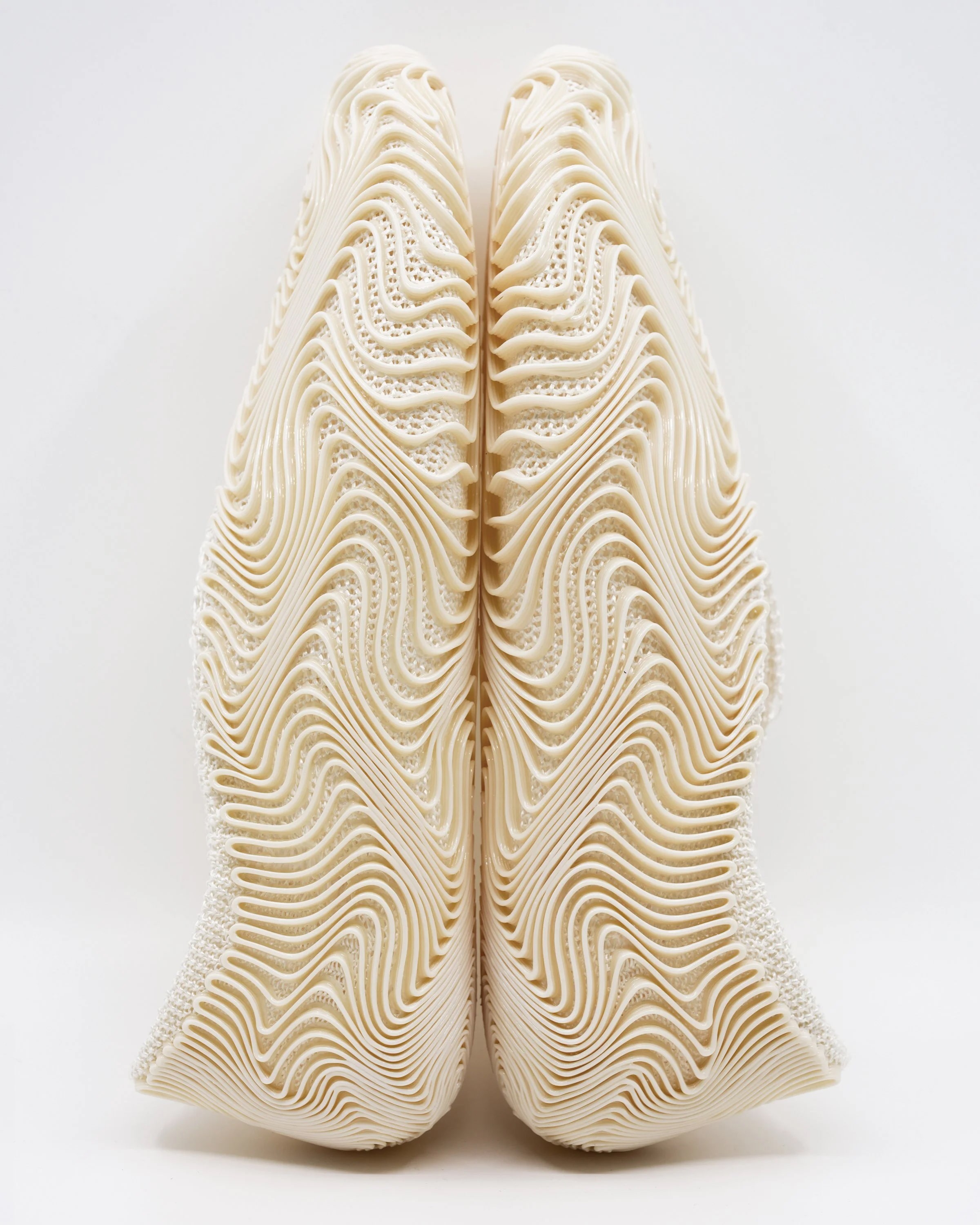
Perhaps the clearest expression of that philosophy is the O° Shoe, a concept that distills years of research into a single consumer product. Made from biologically derived polymers and designed to biodegrade without leaving microplastics, the shoe reimagines footwear as part of a continuous ecological cycle rather than a disposable object. More importantly, it represents a shift in thinking that extends far beyond sneakers. Throughout her career, Oxman has argued that the next era of design will be measured not by what we manufacture, but by how intelligently we manufacture it. As artificial intelligence, robotics, and biotechnology increasingly converge, her work offers a compelling glimpse of that future, one where products are grown with nature instead of built in opposition to it.
Perhaps the clearest expression of that philosophy is the O° Shoe, a concept that distills years of research into a single consumer product. Made from biologically derived polymers and designed to biodegrade without leaving microplastics, the shoe reimagines footwear as part of a continuous ecological cycle rather than a disposable object. More importantly, it represents a shift in thinking that extends far beyond sneakers. Throughout her career, Oxman has argued that the next era of design will be measured not by what we manufacture, but by how intelligently we manufacture it. As artificial intelligence, robotics, and biotechnology increasingly converge, her work offers a compelling glimpse of that future, one where products are grown with nature instead of built in opposition to it.


Explore
More Editions
Explore
More Editions





Work with us
Social
Services:
Strategy
Brand
Digital
Experiences
Our work spans identity, systems, and digital experiences. We partner closely with founders and teams to define how brands are built, expressed, and evolve over time.
©Moment 2026
Work with us
Our work spans identity, systems, and digital experiences. We partner closely with founders and teams to define how brands are built, expressed, and evolve over time.
Social
Services:
Strategy
Brand
Digital
Experiences
©Moment 2026
Work with us
Our work spans identity, systems, and digital experiences. We partner closely with founders and teams to define how brands are built, expressed, and evolve over time.
Social
Services:
Strategy
Brand
Digital
Experiences
©Moment 2026